
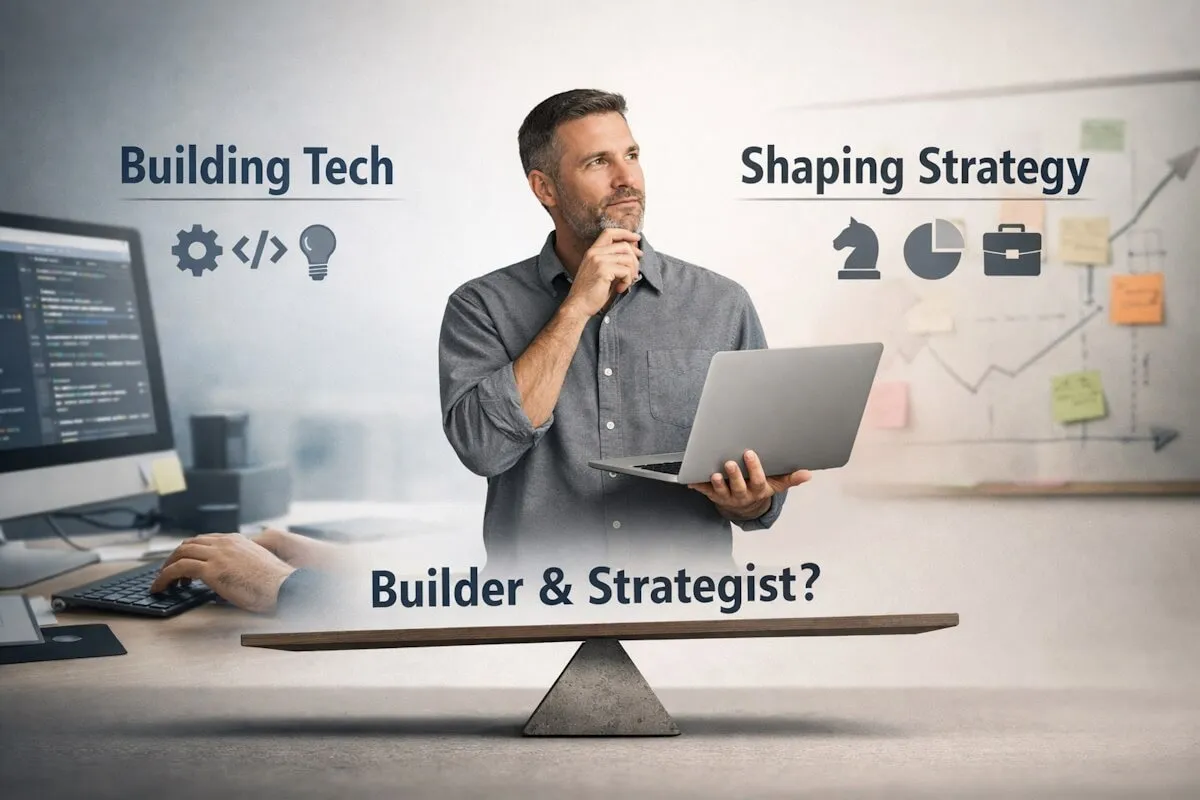
If you ask ten founders what a CTO should do, you’ll probably get ten different answers. Some still picture a hardcore coder glued to a screen. Others expect a big-picture thinker sitting in leadership meetings all day. So what’s the real deal in 2026?
Short answer: it’s both. But that doesn’t tell the whole story.
The role of a CTO has stretched, shifted, and picked up layers over the years. It’s not just about writing clean code or picking the right stack anymore. You’re expected to guide product direction, manage teams, handle risks, and still stay close enough to tech that nothing slips through the cracks.
Let’s break it down in a way that actually makes sense.
The CTO as a Builder: Still Relevant or Fading Away?
There was a time when being a CTO meant you were the best developer in the room. You built the product from scratch. You fixed bugs at 2 AM. You knew every line of code.
That version hasn’t disappeared. It’s just changed shape.
In early-stage startups, the CTO is still very much a builder. You’re expected to move fast, test ideas, and get a working product out before the runway dries up. No room for overthinking.
You might still:
- Write core architecture
- Review pull requests
- Jump in when things break
- Make quick calls on tools and frameworks
But here’s the twist. Even in this builder phase, you’re not just coding. You’re making decisions that affect how the product grows later. One wrong call can slow everything down in six months.
That’s why many founders now lean on teams offering NodeJS Development Services when speed and flexibility matter. It helps CTOs move quicker without building everything alone.
And let’s be real. Trying to do everything yourself? That burns you out fast.
The CTO as a Strategist: More Than Just Meetings
As companies grow, the role starts to tilt.
You’re no longer just building. You’re deciding what gets built and why.
This is where strategy comes in, but not the buzzword kind. Real, grounded decisions like:
- Should we scale the current system or rebuild parts of it?
- Are we hiring in-house or choosing to Hire Node Developers externally?
- How do we balance speed with long-term stability?
You’re working closely with product, marketing, and even sales. Yeah, sales. Because tech decisions now affect revenue directly.
And here’s something people don’t talk about enough. Strategy isn’t about stepping away from tech. It’s about understanding it deeply enough to make smart calls without touching every file.
You’re still technical. Just in a different way.
The Balancing Act: Where Most CTOs Struggle
Here’s where things get tricky.
You can’t stay fully hands-on forever. But if you go too far into management, you lose touch. That’s dangerous.
Teams start making decisions without proper guidance. Technical debt creeps in. Small issues turn into big problems.
So what’s the balance?
Good CTOs in 2026:
- Stay involved in architecture discussions
- Review critical decisions, not every small task
- Set standards instead of writing all the code
- Build systems that don’t rely on them for every fix
Think of it like this. You’re not the person holding the hammer anymore. You’re the one deciding how the house gets built and making sure it doesn’t collapse.
Hiring, Delegation, and Letting Go
Letting go is hard. Especially if you’ve built the product from day one.
But growth forces your hand.
You start asking:
- Do I need senior engineers or generalists?
- Should I build a full in-house team?
- Is it smarter to partner with external experts?
This is where decisions like choosing NodeJS Development Services or deciding to Hire Node Developers can make a real difference. It’s not just about cost. It’s about speed, quality, and focus.
Outsourcing parts of development doesn’t mean losing control. It means freeing up your time for bigger decisions.
And honestly, that’s where you add the most value.
Communication: The Underrated CTO Skill
No one tells you this early on, but communication becomes a huge part of the job.
You’re translating tech for non-tech people. And vice versa.
You need to:
- Explain complex ideas in simple terms
- Align teams with different priorities
- Set clear expectations
If your team doesn’t understand your direction, even the best strategy falls apart.
And if stakeholders don’t understand your decisions, you’ll keep running into friction.
So yeah, being a great CTO isn’t just about being smart with code. It’s about being clear with people.
Risk Management and Decision Pressure
Every decision you make carries weight.
Choosing the wrong tech stack. Scaling too early. Ignoring performance issues. These things don’t just cause headaches. They cost time and money.
In 2026, CTOs are expected to think ahead:
- What happens when user traffic spikes?
- Can our system handle growth?
- Are we building something that can last?
You’re constantly balancing speed and stability.
Move too fast, things break. Move too slow, competitors win.
No pressure, right?
The Human Side of the Role
Let’s not ignore this part.
You’re leading people. Not machines.
Your team looks to you for direction, support, and sometimes reassurance. Especially when things go wrong.
You need to:
- Mentor developers
- Build a healthy team culture
- Handle conflicts
- Keep morale up during tough phases
A strong team can carry a product forward. A disconnected team can stall everything.
And guess who sets the tone? You do.
So, Builder or Strategist?
It’s tempting to pick one.
But the truth is, the best CTOs don’t choose. They adapt.
Some days you’re deep in technical discussions. Other days you’re planning the next six months. And sometimes you’re doing both in the same hour.
The role isn’t fixed. It shifts based on the stage of the company, the team, and the challenges in front of you.
And that’s what makes it interesting.
What This Means for Founders
If you’re hiring a CTO or stepping into the role yourself, here’s something to think about.
Don’t box the role into a single definition.
Look for someone who:
- Can build when needed
- Can think long-term
- Knows when to delegate
- Communicates clearly
- Understands business impact
And most importantly, someone who’s willing to evolve.
Because what works today might not work six months from now.
The Role Is Changing. Are You?
The CTO role in 2026 isn’t about fitting into a label.
It’s about knowing when to switch gears.
You build. You plan. You guide. You step back. Then you jump in again when it matters.
So ask yourself this.
Are you holding on to old expectations of what a CTO should be? Or are you ready to adjust?
Because the companies that win won’t have CTOs who stick to one lane.
They’ll have CTOs who know how to move between them.